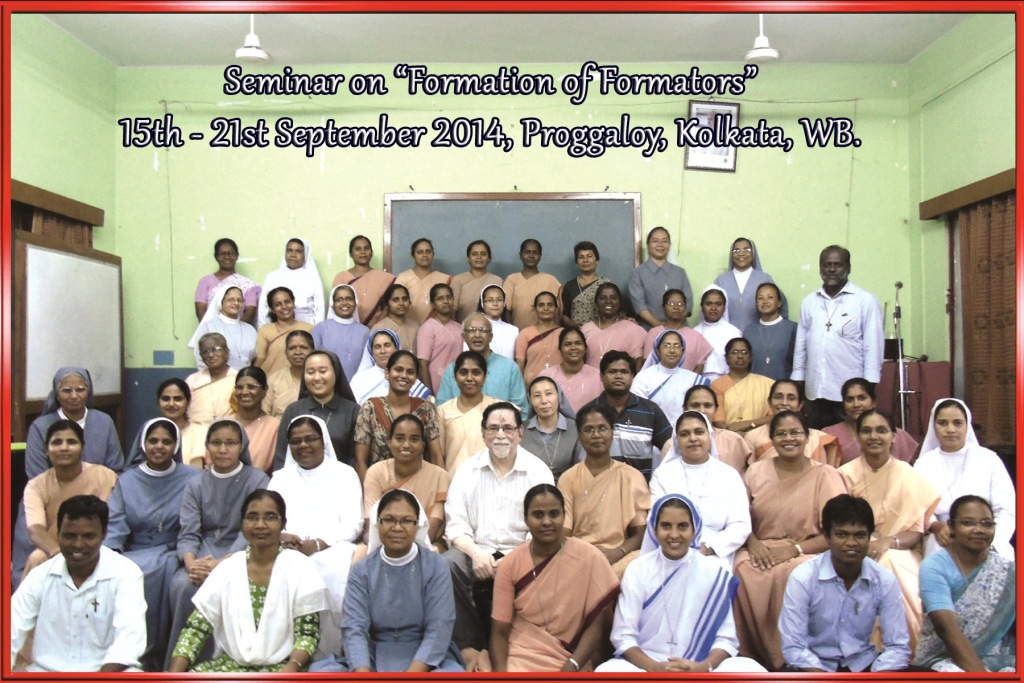
| The National CRI organized a week long seminar on “Formation of Formators” from 15–21 September 2014 at Proggoloy, Barasat, Kolkata. Fifty seven participants, including Srs Teresa Adampakallel and Sr. Lily Perumpettikunnel, from thirty two congregations benefited from this seminar. There were also Sisters from Myanmar and Thailand. Fr Joe Mannath, SDB, was the main resource person of this entire program. Three local Religious stepped in: Sr. Ruth BS, Fr. Jeyaraj Veluswamy SJ, and Fr Mathew George SDB to team up with him. All the resource persons shared from their life experiences and inspired the participants with practical suggestions and valuable insights into the basics of formation. They covered the following areas: aspects and atmosphere of formation houses, human formation and assessment, Discernment, sexuality and celibacy, gender and cultural issues and counseling and spiritual direction. The focus of the sessions was practical tips rather than mere theoretical information. Fr Joe Mannath convincingly emphasized that we should not recruit young people to religious life so as to staff our institutions. Desire to be closely united with Jesus and moved by His values is what characterizes a genuine religious vocation. The call to celibacy is marked by prayer, effective love, inclusive love without “walls” and healthy boundaries. Sr. Ruth BS, focused on “Formation of women Religious” She also spoke of formation as a mission and for a mission. Formation is to draw out the potentialities of the formee. Fr Jeyaraj Veluswamy systematically explained the importance and process of discernment. It would certainly be a helpful tool in the hands of the formators as they strive to seek, find and do the will of God in their mission of accompanying formees in their vocational journey. Fr. Mathew George who had been a formator for fifteen years, enlightened us on the topic “Human Formation.” He shared with us some helpful points regarding assessment of formees. After attending the sessions by different resource persons, we began to feel that the formators’ role is something like that of parenting, rather than a master’s or a lecturer’s role. A formator not only leads or guides, but sees to the all around growth of formees whom he takes care of. When a formator is truly interested in the growth of the formees, the formees are able to sense it and will be more open and will easily approach for help. Formees can be helped anywhere, not only in the classroom. Therefore, formators’ availability and formees’ learning cannot be restricted only to the classroom. The atmosphere in formation houses without “Fear Complex” is the sole responsibility of the formator. Exemplary life also has a great influence on formees. A formator is not required to teach everything. Most of the learning can be achieved by formees by seeing and observing the formators’ exemplary life: her/his way of living religious life, carrying out responsibility, ways of dealing and interacting with other religious and people outside. All the resource persons drew our attention to religious life and formation in a multicultural set up, its richness and challenges. The participants departed from Proggaloy convinced that formators are called to be loving, joyful, God- centered and inspiring models to our formees. |
 FMA INC News Update